Showing posts with label Travel. Show all posts

Wednesday, June 13, 2018

Can't Get Enough of that Biosphere 2!

We really enjoyed our tour.  Here are some other things we saw, and some suggestions for further reading.

Rock Sculptures at Biosphere 2, Oracle, AZ.  Image ©2018 Tina Quinn Durham.

A beautiful desert vista at Biosphere 2, Oracle, AZ.  Image ©2018 Tina Quinn Durham.
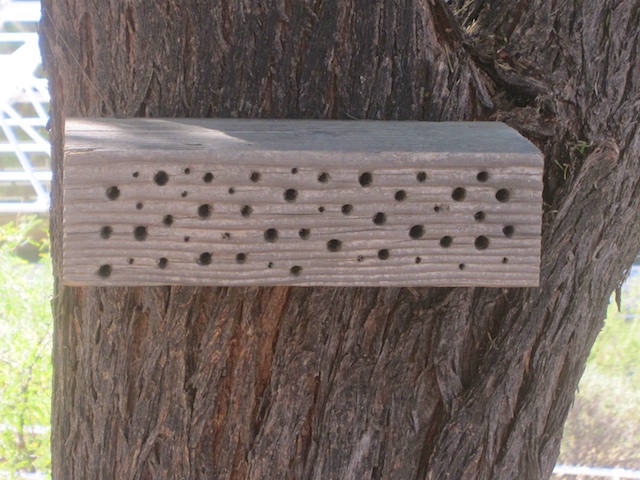
In addition to water harvesting and other earth-friendly features, there were bee condos, and instructions on how to make your own to provide homes for solitary bees - which are important pollinators in our desert environment.

Bee Condo. Image ©2018 Tina Quinn Durham.

One last photo of something near and dear to my heart: aquaponics.  We have two tanks in our home in preparation for a full-scale greenhouse, which I hope to get around to finishing someday.  Aquaponics uses fish poop to fertilize plants, and is a very efficient way to produce vegetables, herbs, and protein in the desert.

Aquaponics, Biosphere 2, Oracle, AZ.  Image ©2018 Tina Quinn Durham.

More About Biosphere 2

"Fast Facts:  Biosphere 2 by the Numbers" - description of Biosphere 2 from the University of Arizona/Biosphere 2.

Dempster, William F. “Biosphere 2 Engineering Design.” Ecological Engineering, vol. 13, no. 1-4, 1999, pp. 31–42., doi:10.1016/s0925-8574(98)00090-1.
         This article is quite technical, but a great geek read nonetheless.

Didn't get enough homework at school?   Check out this problem from Fundamentals of Chemical Engineering Thermodynamics by Kevin D. Dahm and Donald P. Visco (Independence, KY: CENGAGE Learning, 2014.)

Want to read some poetry about Biosphere? 
Deming, Alison Hawthorne et al. “Poetic Field Research at Biosphere 2 Archives • Terrain.org: A Journal of the Built + Natural Environments.” Terrain.org: A Journal of the Built + Natural Environments, Terrain.org, 4 Sept. 2014, www.terrain.org/category/poetic-field-research-at-biosphere-2/.

Thursday, February 1, 2018

Biosphere: Sing it out, honey!

Lung, Biosphere 2, Oracle, AZ.  ©2018 Tina Quinn Durham
If you're gonna sing, sing loud (Travis Tritt)

A less terrifying but equally fascinating part of the Biosphere 2 tour was its now non-functional lung. Hold on, you say. How can a building have a lung?

Biosphere 2 was designed to be a closed system, illuminated by the sun through 6,500 glass windows. Glass is rigid; it does not freely contract or expand as the temperature changes. So when the morning sun hits those glass windows, 7,200,000 cubic feet of air heat up, expanding far beyond the ability of glass to compensate. When the sun sets, the air inside Biosphere 2 cools and the process reverses.  The air inside the building contracts, creating another potential window-shattering catastrophe.  That's why the engineers gave Biosphere 2 a way to compensate for dramatic changes in air pressure.

Biosphere's two-towered "lungs" were an ingenious solution.  Each tower housed a ginormous metal disk, or membrane, that could rise or fall with the air pressure, relieving stress on the glass walls and keeping Biosphere 2's closed system intact.

These lungs also had a second vital function, which one day may also prove important to the Mars colonists: water collection.  At night, as Biosphere 2 cooled, water condensed on the huge membranes of the lung, filling a 200,000 gallon tank with clean water.  This stored water could then be used to fight fires or to replace moisture lost to evaporation within the various ecosystems.  In a closed system, both fire-fighting and drinking water are vital to survival.

What I found most interesting, however, had nothing to do with fire fighting, water or engineering.  The lung room is an awesome echo chamber!  I tried to convince my husband to sing a major triad in harmony with me, to create a chord that would reverberate thrillingly throughout the chamber, but my husband would have none of it.  He left me to sing alone, human lung to aluminum lung.

I want to go back with a choir!

Monday, November 20, 2017

Entering the Land of the Morlocks

Biosphere 2, Technosphere Hallway
@2017 Tina Quinn Durham
Our tour of Biosphere included a tour of the “Technosphere” - the 3.14 acres of ductwork, pipes and machinery which allow life within Biosphere 2 to breathe, get moisture, and in general survive.
As soon as I stepped through the door into the tunnel, I immediately thought of H.G. Wells, and started looking for dangerous little humanoids that were clever with machines but might want to eat me.

None appeared, and our guide seemed well-fed enough for me to continue the tour, despite my misgivings.

For the engineers among us, a few facts:

The technosphere includes 26 air handlers that can control moisture and humidity as well as oxygen and C02 levels, and of course heat or cool the air as required.

Having so much control over temperature and humidity allows scientists to discover what happens if a rainforest experiences several weeks of drought. They cannot control the ocean, but at the coral reef in Biosphere 2, they can study corals respond to increased levels of CO2 or higher water temperatures.

Our guide told us about an interesting experiment in the rainforest. The biome was flooded with CO2, and it turns out that increased CO2 levels don’t lead to more and more plant growth. Instead, there is an upper limit to how much carbon that plants can absorb and sequester - and it is possible for Earth to go beyond that limit.

Not only that, but other studies have shown that increased levels of carbon dioxide can actually reduce the nutrient value of important crops like rice and wheat.

Scary, huh?


"Biosphere 2 Gives Up Some of its Secrets" - an informative article about the technosphere from The Green Valley News.

Fast Facts - Biosphere 2.

More Carbon Dioxide in the Air Makes Some Crops Less Nutritious

Thursday, November 2, 2017

No Diversity - No Survival

The ocean & coral reef at Biosphere 2 - "the world’s biggest controlled marine research facility"
@2017 Tina Quinn Durham
How much of the world can you squeeze into 3.14 acres?  Biosphere managed to fit an ocean, a fog desert, a rainforest, a mangrove wetland, a savannah, and agricultural areas that included rice ponds with tilapia, vegetable gardens, and grain fields.  Not to mention living space for humans and a variety of agricultural animals including pigs, goats, and chickens.  An impressive microcosm of large, complex planetary systems.

The Rain Fog Desert at Biophere 2
@2017 Tina Quinn Durham

One detail particularly impressed me:  the planners included a fog desert specifically because the plants there are actively producing oxygen in winter, when flora in other biomes are dormant and not producing the oxygen we need to survive.  Suddenly, I realized why we need two hemispheres with winter in one and summer in the other, and how important it is that global weather patterns act like a planetary fan to mix all that oxygen up and move it around.

The Rain Forest at Biosphere 2
@2017 Tina Quinn Durham
The inhabitants of Biosphere 2 suffered a debilitating shortage of oxygen despite the careful planning that went into creating Biosphere when exposed concrete absorbed both carbon and oxygen.  There were other setback too, when the pollinating insects died and the cockroach and ant populations exploded.  Even their bodies had to adapt to a low-calorie, high-nutrient diet, and the Biospherans literally felt hungry for an entire year until their metabolisms adjusted.

We cannot predict what effect climate change and altered weather patterns might have on our larger biosphere.  We already know that bees are in trouble, and flying insect populations are decreasing.  How that will affect the quality of human life and the success of our food production remains to be seen.

However, one fact is painfully clear:  humanity cannot survive without biodiversity.  To live, to breathe, to have potable water and survivable weather conditions, we need diversity.  Everything matters from the smallest microbe to the largest apex predator.

We do not exist in isolation from Biosphere 1.


Bibliography

Wikipedia. “Biosphere 2.” Wikipedia, Wikimedia Foundation, 30 Oct. 2017, en.wikipedia.org/wiki/Biosphere_2.


Wednesday, November 1, 2017

The Future of Arid-Land Farming: Aquaponics at Biosphere 2


I was thrilled to see an aquaponic garden at Biosphere.  The basic idea is that fish poop in the water, the water is pumped up to the planting beds, the plants filter out the nutrients, and the water is returned to the fish tanks to be replenished with more organic nutrients from fish poop.  You can grow a variety of herbs and vegetables, and you can use different fish species too, depending on your climate.  In central and southern Arizona, most people seem to be use goldfish, koi and tilapia because it’s too warm for trout.  Catfish are a possibility too, but I haven’t seen much about people using them in Arizona.  That may have something to do with their water and filtration requirements compared to less demanding species like tilapia.

As human population continues to grow and demand for water increases, we will need innovative methods of food production - especially in desert regions like California and Arizona.  Locally grown produce and fish that’s organic and uses less water than traditional farming methods?  I’m all for it!

When humans begin to colonize other worlds, aquaponics will almost certainly play a role in their food production too.


By the way, our guide mentioned that one of his friends grows hops - an essential ingredient for home-brew beer - in his aquaponics garden.  Yep, there is definitely a future for aquaponics!

For more information on aquaponics, a good place to start is the National Agricultural Library (online) at the USDA.

Tuesday, October 31, 2017

Not Mutually Incompatible


© 2017 Tina Quinn Durham
When you think about science, it’s easy to imagine a sterile laboratory with glass petri dishes, neat rows of test tubes and mysterious machines tended by people in white coats. It’s harder to imagine scientific discovery happening in a stunningly gorgeous natural setting, but that is exactly what is happening at Biosphere 2. Nestled among the rugged southern edge of the Rocky Mountain ranges are bee houses, flowers, trees, and even a sculpture garden. Paths lead you past boulders and rocks meant to educate the mind - and delight the eye. Biosphere 2 even has an artist-in-residence program.

Science and beauty can exist side by side, and strengthen one another. The order and beauty of nature are not inimical, but rather, intrinsic to the mission of Biosphere 2.

(This reminds me of a poem - I feel a song coming on..... "Ode to a Grecian Urn" by John Keats....)


Sunday, October 29, 2017

Sightseeing in my own backyard
(well, sort of)

Biosphere 2 rises out of the landscape like a futuristic cathedral.
Photograph © 2017 Tina Quinn Durham
Biosphere surprised me.  My memories of it, from the ‘90s, were of sensationalism and a vague sense of science gone bad. 

I suppose that one ought to expect failures when attempting to do something incredibly difficult for the first time.  After all, no one had ever before attempted to simulate an interplanetary mission to colonize another world.  “No material in, no material out” for two years was a truly ambitious goal.

The logistical problems encountered and solved in those first Biosphere attempts will probably save many lives in the future.  Scientists learned a great deal from those experiments, including the surprising fact that concrete can absorb oxygen and threaten the stability of a closed ecosystem. 

Nevertheless, I had casually dismissed the Biosphere project as irrelevant, a mere tourist attraction from a by-gone era.

Then I found a book in a thrift store about Biosphere, and flipping through it rekindled my desire to see the actual Biosphere project.  Yet years passed, the book sat on my shelf unread, and we did not take a day to visit Biosphere.

The book that spurred me into action.

In 2017, Hurricane Irma struck the Caribbean island we were supposed to visit.  The hurricane removed the fourth floor from our hotel and radically changed our travel plans.  We decided to stay closer to home and to explore the state in which we live.

The journey shaped itself around one destination:  Biosphere 2, in Oracle, Arizona - 120 miles from our home.  Sixteen years after its inception, we were finally visiting Biosphere 2.


More About Biosphere 2

 “Life in Biosphere 2.”  In her TED talk, Jane Poynter talks about what it was like living for two years in Biosphere 2, and advises Tucsonans to throw away their rakes.

Biosphere 2 - the official website

The Wikipedia article on Biosphere 2 - a nice overview, with lots of history


Thursday, October 26, 2017

Spring Food from the Sonoran Desert

Cholla Blossoms, McDowell Mountain Regional Park.  © 2017 Tina Quinn Durham
Cholla - the same cactus that modern hikers hate and fear - actually sustained Native Americans in the past.  After a winter of dried foods, the Tohono O'odham would carefully gather the cholla buds just before the cactus flowered in the spring.  Then they would carefully clean off the spines, and boil or roast the buds, which are low in calories but high in calcium.  And of course, they were careful not to harvest all the buds, because they understood that sustainability is critical to a society’s long-term survival.

Today, people use tongs to harvest the buds, and clean off the spines with a screen box, rolling the buds across the screen with a whisk broom, and then pulling off the remaining spines with tweezers.  This is definitely not fast food!

Cholla buds could be cooked fresh, or dried and cooked later.  But raw cholla buds contain oxalic acid which irritates the throat of any human unfortunate enough to eat a freshly picked cholla bud.  Fifteen minutes of boiling will remove the acid, and then the cooked buds can be added to other dishes.

However, javalina, jack rabbits and pack rats can all digest oxalic acid, and so eat the fruit of the cholla and the prickly pear without damaging their esophagi.  Which is fortunate for them, because they don’t have access to a kitchen!


Works Cited

Acoba, Elana. “It's Harvest Time for Cholla Buds, a Subtle, Versatile Native Food.” Arizona Daily Star, Tucson.com, 8 Apr. 2012, tucson.com/lifestyles/home-and-garden/it-s-harvest-time-for-cholla-buds-a-subtle-versatile/article_c9e74554-3c65-5976-ac29-bd3668399c5a.html.

Engols, Kimberly, and Season Eggleston. The Incredible Edible Desert. Ecology & Evolutionary Biology Dept., University of Arizona, 2010, eebweb.arizona.edu.

Tohona O'odham Community Action. “Ciolim: Cholla Cactus Buds.” Tocaonline.org, Tohono O'odham Community Action, ND, www.tocaonline.org/ciolim.html.


Wednesday, October 25, 2017

Surprised by a Sahuaro

Sahuaro, McDowell Mtn. Regional Park, AZ.  ©2017 Tina Quinn Durham
I was going to write a post about sahuaros that was replete with intriguing scientific facts about this unique cactus which grows only in one desert in the world - the Sonoran desert of the American Southwest and northern Mexico.  Instead, I ended up writing a poem about sahuaros which might actually be a publishable piece of work.  When it hits a small press magazine, I'll let you know.

Meanwhile, a couple of fun facts about sahuaros:

You may have known that Lesser Long-Nosed Bats are a primary pollinator for sahuaros, which bloom at night.  What you may not have realized is that the flowers stay open until the following afternoon and that the white-winged dove is an important pollinator of sahuaros.  This dove actually times its migration to coincide with the flowering and fruiting of the sahuaro cactus ("Migratory Pollinators," Arizona-Sonora Desert Museum).

Another surprising bit of information:  a sahuaro cactus may weigh up to 8 tons, and its roots can absorb 200 gallons of water during a single rainfall.  That's over 1600 lbs. of water! ("Sahuaro Roots," National Park Service).

Here's the last weird thing about sahuaros:  they have shallow root systems.  Although the roots may extend several feet in all directions, they're only a few inches deep (ibid).  You'd think something as tall and heavy as a sahuaro might be more like mesquite trees, with tap roots that reach down a very impressive 200 feet into the soil (Dimmitt, "Plant Ecology of the Sonoran Desert Region").  But no, three to five inches deep is all a sahuaro needs to survive for over 100 years in its desert environment.

Which just goes to show you that there's more than one way to live in harmony with your surroundings, and to thrive even in harsh conditions.

Tuesday, October 24, 2017

Just another amazing Arizona sunset

McDowell Mtn. Regional Park.  ©2017 Tina Quinn Durham
When we got to McDowell Mountain Regional Park and set up camp (inasmuch as one ever sets up camp in a motorhome), the first thing I did was put on the hiking boots and head down the spur toward the Granite Trail. It was a spectacular sunset and a lovely, peaceful hike.

Moments like these are why we live in Arizona!

Monday, October 23, 2017

Another Road Trip - Arizona Oct. 2017

Sabino Canyon, near Tucson, AZ.  ©2017 Tina Quinn Durham
Okay, this was kind of a weird vacation for me because it was more or less unscripted in that we knew what places we wanted to visit, but didn’t have reservations or a fixed timetable.  Also, because we were camping in various state, national or regional parks, it was different from any RV’ing I had done before.

DAY ONE: TUCSON AND SABINO CANYON.  Sabino Canyon is one of the places I’ve always wanted to visit, and I’ve rather envied Jeff the opportunity to hike there as a teenager.  Having two kids within two years of getting married really cramped our style when it came to hiking, or doing anything that required money.  Now, however, the kids have been grown for a long, long time, and we're finally getting around to some of the items on my bucket list.

The National Forest Service website says that "over a million visitors a year" come to see the "soaring mountains, deep canyons, and the unique plants and animals" in Sabino Canyon.  The rugged landscape and the sahuaro cacti are definitely worth the visit.

I was impressed with the quality of the narration on the tram ride.  The driver knew the plants and animals in the area as well as the natural and human histories of the canyon.  Not only that, he could get across the narrow stone bridges without falling off!

We didn't do much hiking because of the heat.  Yes, even though it was mid-October, the afternoon was still too hot, and it didn't matter that it was a dry heat.  It was just too hot. Nevertheless, we got off at the last tram stop, wandered around a bit and enjoyed the amazing vistas before heading back to civilization.


The other high point of our day was lunch at Brushfire BBQ in Tucson.  Pulled pork sandwiches with a sweet, hot BBQ sauce, topped with fresh creamy coleslaw and washed down with Prickly Pear Iced Tea.  What could be better than that?


Tuesday, September 5, 2017

2017 Road Trip: From Bomb to Art

We saw this V2 Rocket Engine at the New Mexico Museum of Space History, and I couldn't resist photographing it.  Such wonderful geometry inside such a deadly object.


I couldn't resist playing with the image in Photoshop Elements either.


You might find this as an abstract print in a hotel room somewhere, or hanging in a museum.  I could have an artist's statement about the vital role of art in transforming images of death into images of beauty, hope or life.  I could make some reference to the Bible, and turning swords into ploughshares.

But I think I'd rather just leave you with this evocative image instead.

Wednesday, August 23, 2017

2017 Road Trip, Day 2: Alamogordo, NM

New Mexico Museum of Space History
Our original plan was to drive through El Paso and see the Border Patrol Museum — which, if you look their website, seems to be pretty campy and is rumored (by them) to be "one of our Nation’s best kept secrets."  However, the museum was closed on Mondays, so we went through Alamogordo instead.

Our alternate route brought us to the New Mexico Museum of Space History instead, and three flags waving proudly in the wind.

If you've never crouched down on the sidewalk while your significant other walks in circles around you, sighing impatiently as you try repeatedly for the perfect shot, you cannot truly appreciate the effort that went into this photograph.

Don't worry - my DH got over his grumpiness when he got to explore space junk!

Friday, August 18, 2017

2017 Road Trip: Day One, Mesilla, NM


The old church in Mesilla is supposed to be one of those must-stop destinations for tourists, but we found the doors locked.  We wandered around outside dutifully, and I got some nice shots, but it was actually rather depressing, with all the memorials for those lost in war, and the little memorial for those lost to abortion.

We knew it would be a long day of driving, which it was.  I think that sometimes I want to make New Mexico something other than it is, which is gloriously empty, dry land.  It makes sense to an Arizonan mind.  But it's also got these lovely mountains, and slightly different flora because it's a different desert with a different rainfall pattern.  Water is everything, especially when you get less than 19" of rain every year.

So what do I remember from that long day of driving?  Nothing except a sense of happiness.